Crossfade
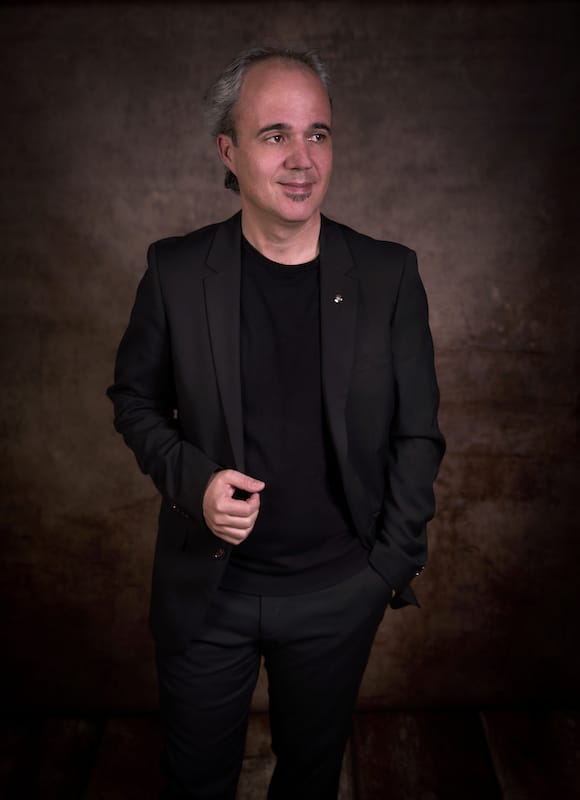
Mark Engebretson is a professor of composition and music technology at the University of North Carolina at Greensboro. His music explores melody, timbre, and virtuosity through clear formal design, while often integrating new media and popular influences. A recipient of a Fulbright Fellowship, Engebretson’s music has been commissioned by the Fromm Music Foundation and Barlow Endowment. Engebretson’s works have been performed widely in the United States and abroad. Crossfade was commissioned by Stephen Squires and the Chicago College of Performing Arts Wind Ensemble and premiered in 2017. The title references the process of blending one sound or idea into another: a technique familiar in audio production. Throughout the piece, musical textures and colors overlap and transform as ideas emerge, fade, and reappear in new contexts. Crossfade unfolds in three large sections: an energetic opening characterized by rhythmic motion and bass-driven motives, a slower and more texturally experimental middle section, and a return of the opening material transformed with new energy and melodic material. The work’s vibrance, intricate layers, and buoyant rhythms create what the composer describes as “a bubbly concoction of energy, rhythm, and joy.”
Note by Mark Engebretson and Molly Allman
Theme and Variations, op. 43a
Arnold Schoenberg, largely self-taught and originally from Vienna, immigrated to Los Angeles in 1934. While in the United States, Schoenberg taught at UCLA while composing until a heart attack in 1945 led him to retire from teaching in order to focus on composition. Schoenberg is best known for “emancipating dissonance” through his move away from tonality and toward atonality where music lacks a key center. This idea led to his development of 12-tone technique, a revolutionary approach to composition that has come to define his legacy. However, this contribution represents only part of his creative output which also includes his significant and tonal composition for band: Theme and Variations, op. 43a. Written while Schoenberg was living in Los Angeles, Theme and Variations, op. 43a was composed at the request of Carl Engel, president of G. Schirmer Music, following a request from Edwin Franko Goldman, for an original composition for band. Centered in G Minor, the work consists of a theme, seven variations, and a finale. Each variation is based on the original theme and developed through fragmentation and motivic transformation, while incorporating tempo variation, a waltz, an inverted canon, and a chorale. The multi-part finale includes a double fugue and a coda that transforms the tonality from G Minor to G Major.
Note by Patty Saunders
Black Dog
Scott McAllister is an American composer, educator, and clarinetist. McAllister attended Florida State University where he studied conducting with the director of bands, James Croft, and clarinet with Frank Kowalsky. In 2001, following the success of his previous work for clarinet, X Concerto, Croft and Kowalsky commissioned McAllister to write another clarinet concerto which became Black Dog. Written to showcase Frank Kowalsky’s technique, Black Dog draws inspiration from 1970s rock music including guitarists Jimi Hendrix and Jimmy Page, and more specifically Led Zeppelin’s song “Black Dog.” The piece is intended to evoke the feeling of an outdoor concert, with the clarinet soloist serving as the lead singer in front of a screaming audience. To further emphasize the “rock” feel of the piece, McAllister chose to write it as a rhapsody, which allows for more formal freedom. The soloist is featured in several cadenzas before a “head-banging” bass line propels the piece to a rousing conclusion.
Note by Scott McAllister and Jaden Brown
Gloses II
Spanish composer Amando Blanquer Ponsoda studied horn with Don Fernando de Mora and composition at the Conservatory of Valencia with Leopoldo Magneti, Manuel Palau, and Miguel Asins Arbó. In the 1950s, he received a scholarship to study in Paris and studied composition with Olivier Messiaen. Blanquer won several awards including the Rome Prize in 1962. Upon moving back to Spain, he served as the chair of composition at the Valencia Superior Conservatory of Music. His prolific output of more than three hundred works spans symphonic, chamber, choral, and solo music. His significance as a band composer is evident in his works for band and with his background playing in the Primitive Band of Alcoy. Considering his compositional style, Blanquer remarked “each musical idea is born from the element that originates it—whether it be an orchestra, a band, an oboe, a guitar.” Gloses II is part of a trilogy, alongside Gloses for organ (1987) and Gloses III for symphony orchestra (1990). Commissioned for the Festliche Musik Tage in Switzerland, it was also featured at the Valencia International Wind Band Competition in 1991. In Spain, a “glosa” is a poetic form that expands on a pre-existing short text, typically a four-line stanza. In music, the “glosa” generates melodic variations—a tradition rooted in Valencian Baroque music, notably in the works of organist Joan Baptiste Cabanilles (1644–1712). The five-movement work is a musical interpretation of a “glosa” and opens with a four- note melody in the low brass, which serves as thematic material used throughout the work The second movement highlights the oboe and bassoon with contrasting lyrical lines and dance-like rhythms. Chimes signal the beginning of the third movement, which opens with a horn solo which is developed across the ensemble before resolving to a D Major chord. The fourth and longest movement features a chaotic texture, with frantic, fragmented rhythms interspersed with slower, lyrical passages. The final movement marked “Allegro jubiloso,” begins with tom-toms and marked chords. Woodwind and high brass rhythmic sections, a reintroduction of oboe and flute solos, and fanfare-like brass are showcased. The rhythmic motive is then imitated in the timpani in the final measures to bring the piece to a triumphant and full ensemble E Major chord.
Note by Patty Saunders
Invocación
Luis Serrano Alarcón is a Spanish composer and conductor who writes primarily for band. In 2017, La Armónica, the symphonic band at Centro Instructivo Musical (CIM) in Buñol, Spain, commissioned Alarcón to compose Invocación. The piece was premiered as part of the band’s competition repertoire for the World Music Contest, a month-long music festival in Kerkrade, Netherlands. Invocación is based on Isaac Albeníz’s piano suite Iberia, specifically, the second movement, “El Puerto” which Alarcón performed as a child. Alarcón draws inspiration from his experiences and memories with Iberia in Invocación. The piece’s subtitle, “Revisitando El Puerto,” refers to both the revisitation of old music and a revival of the actual location that inspired Albeníz’s “El Puerto”: El Puerto de Santa María in Cadíz, Spain. Additionally, the title Invocación is subtle reference to the first movement of the piano suite, “Evocación.” These similarities and connections were specifically chosen by Alarcón for a reason: “While to evoke is to remember in an intervening way or motivated by something external, to invoke is a request, and therefore denotes intention.”
Note by Luis Serrano Alarcón and Jaden Brown
Amparito Roca
Jaume Teixidor was a Spanish composer and conductor who spent most of his career leading municipal and military bands throughout Spain, including the Baracaldo Municipal Band in northern Spain. He wrote more than five hundred compositions for concert band, many of which became staples of Spanish band repertoire. Amparito Roca is a pasodoble; a traditional Spanish military march in duple meter with brisk-like rhythms and bold melodic themes, often associated with bullfighting and festive celebrations. Named after Teixidor’s piano student, Amparito Roca, for whom he originally wrote the piece as a study work, the piece opens with a spirited introduction, followed by the main theme, alternating with lyrical and dance-like passages. Its lively rhythms, dynamic contrasts, and melodic flourishes capture the character of the Spanish pasodoble.