- This event has passed.
Wind Ensemble

Hub New Music
Free
October 9, 2025 | 7:30 pm – 9:00 pm
Jonathan Caldwell, conductor
Hub New Music
Gala Flagello, composer
Patty Saunders, graduate conductor
Program
ANNA CLYNE
Masquerade (2013/2018)
transcribed by Dennis Llinás
SHUYING LI
In This Breath (2025)
GALA FLAGELLO
The Bird-While (2022)
Avian Gods
Fragile, Vanishing Gifts
Survive
SILVESTRE REVUELTAS
Sensemayá (1938/1990)
transcribed by Frank Bencriscutto
PAUL HINDEMITH
Symphony in B-flat (1951)
Moderately fast, with vigor
Andante grazioso
Fugue (rather broad)
Masquerade

Masquerade draws inspiration from the original mid-18th century promenade concerts held in London’s pleasure gardens. As is true today, these concerts were a place where people from all walks of life mingled to enjoy a wide array of music. Other forms of entertainment ranged from the sedate to the salacious with acrobatics, exotic street entertainers, dancers, fireworks and masquerades. I am fascinated by the historic and sociological courtship between music and dance. Combined with costumes, masked guises and elaborate settings, masquerades created an exciting, yet controlled, sense of occasion and celebration. It is this that I wish to evoke in Masquerade.
The work derives its material from two melodies. For the main theme, I imagined a chorus welcoming the audience and inviting them into their imaginary world. The second theme, Juice of Barley, is an old English country dance melody and drinking song, which first appeared in John Playford’s 1695 edition of The English Dancing Master.
— Anna Clyne
In This Breath

In This Breath was premiered by the Baylor University Wind Ensemble at the March 2025 CBDNA National Conference in Fort Worth, Texas. It was composed in memory of Glen Adsit. Li offers the following regarding the piece:
“My nature is the nature of the cloud—the nature of no birth and no death. Just as it is impossible for a cloud to die, it’s impossible for me to die. I enjoy contemplating my continuation body, just as the cloud enjoys watching the rain fall and become the river far below. If you look closely at yourself, you will see how you too are continuing me in some way. If you breathe in and out, and you find peace, happiness, and fulfillment, you know I am always with you, whether my physical body is still alive or not. I am continued in my many friends, students, and monastic disciples.” Thich Nhat Hanh – The Art of Living
This quotation comes from Thich Nhat Hanh’s The Art of Living. This book is a collection of the Vietnamese monk’s ruminations on life and death that guided my partner Glen Adsit through his personal struggles when confronted with his own mortality. As well as being my beloved life partner and musical collaborator, Glen was a beloved figure in the music community who touched the lives of countless collaborators and students. In the wake of Glen’s sudden passing in January 2024 we have all become the rain to Glen’s cloud. His inextinguishable spirit and profound influence continue to resonate deeply within all of us. Although his physical body is no longer with us, we now constitute his continuation body and are charged with continuing his legacy of support and love for one another.
This piece is a tribute to Glen, the physical life we shared together, and the new life we share as I continue his legacy in my own way. It reflects the profound love and connection we share, both personally and through our collaborative musical endeavors. The piece is lyrical and tender, inviting listeners into the intimate emotional spaces Glen and I navigated together. It captures the essence of Glen’s loving spirit—missed by many, cherished by those who experienced his warmth and guidance, and still apparent in the life and work of his family, colleagues, and students. It is both a celebration of Glen’s life and the enduring bond he and I share and a tribute to the legacy of love and artistic collaboration that he left behind for all of us to continue together. Glen Adsit was a conductor and trombonist. He served as the director of bands at The Hartt School and the national president of the College Band Directors National Association.
As the piece concludes, the ensemble decrescendos to silence making space for a solo trombone crescendo as a tribute to Glen Adsit, a trombonist, and his enduring legacy.
— Shuying Li and Patty Saunders
The Bird-While
The Bird-While (2022) is a concerto for flute, clarinet, violin, cello, and symphonic winds commissioned by Hub New Music. The piece is titled after and based on Keith Taylor’s poem Acolytes in the Bird-While, which explores the flora and fauna of Michigan and the struggle to persist in the face of climate change. I aimed to write a concerto for an unconventional group of instruments that demonstrates their virtuosity while providing a platform for awareness of and education around environmental and climate justice. Each movement derives its title from Taylor’s poem, drawing attention to pivotal lines in the poem’s narrative.
The first movement, Avian Gods, is inspired by the calls of the pileated woodpecker and redstart warbler, two Michigan bird species central to Taylor’s poem. This movement’s 5/8 motif follows the woodpecker’s five-note call, often separated into three- and two-note groupings that can be heard in both the soloists’ and ensemble’s parts. Snap pizzicato in the solo violin and cello evoke the woodpecker’s pecking, and the ensemble’s driving 5/8 ostinato conjures the warbler’s high, repetitive five-note shriek.
The second movement, Fragile, Vanishing Gifts, highlights the individual natural elements that surround us every day. The flute, clarinet, violin, and cello articulate the future loss of these elements due to climate change as they introduce the movement’s theme separately, then come together in canon; our environment is a delicate balance between the individual and the collective. This theme originates from my Moon Dream (2020) for solo soprano saxophone, an early pandemic-era lullaby commissioned by Latitude 49 for their Bagatelles Project in support of the Coalition for African Americans in the Performing Arts.
The third movement, Survive, is both a question and a call to action: can the performers — and our environment — withstand disruption and damage? As I was writing this movement, my best friend and horn player, Marina Krol Hodge, suddenly passed, leaving me pondering my own ability to weather life’s storms. Dedicated to Marina, Survive features horn solos and a brass chorale throughout to commemorate her bright, resilient spirit and her support of new music. The movement’s title also references the way in which music itself might survive through history, which I illustrate by quoting the prelude of J.S. Bach’s Violin Partita No. 3. Two more nods to Bach appear later in this movement in the solo violin and cello. Piping plover calls are referenced in the fleeting, staccato woodwind parts, and the movement’s focus on quintal harmony and recurring fifths harken to the woodpecker’s opening five-note call.
5% of proceeds from The Bird-While sales and rentals will be donated to the Bird Center of Michigan.
— Gala Flagello
Sensemayá

Revueltas wrote little explanation about his composition Sensemayá, and the meaning/relationship of the music to the poem has been the basis for much scholarly debate for the past eighty years. Revueltas heard Afro-Cuban poet Nicholas Guillén recite his poem Sensemayá in 1937 and was taken by the text and rhythm of the poem. The word sensemayá is a combination of sensa (Providence) and Yemaya (Afro-Cuban Goddess of the Seas and Mother of Earth), one of the godSensemayá was the work that brought Silvestre Revueltas to international attention. It was through a recording of the work made by Leopold Stokowski in New York in December 1947 that widespread audiences outside of Mexico began to get an idea of Revueltas’ music.
Revueltas had died in 1940 from complications of chronic alcoholism, his music virtually unknown outside of Mexico, some performances given during a trip to Spain in 1937 notwithstanding. The last decade of his life had been devoted to music, with Revueltas active as a composer, teacher, and conductor in Mexico City. Between 1928 and his death, Revueltas had composed roughly 60 works, including orchestral, chamber, vocal, and theater pieces, as well as a handful of film scores, such as Redes (released in English as The Wave, 1936) and La noche de los mayas (The Night of the Mayans, 1939).
Revueltas had a varied and useful musical education, comprised of a fair amount of practical experience. After three years in Mexico City (1913-1916), Revueltas traveled to the United States, where he studied violin and composition in Austin and Chicago. In the late 1920s, he played violin in a theater orchestra in San Antonio and conducted an orchestra in Mobile, Alabama. He returned to Mexico in 1929, when Carlos Chávez, one of the country’s foremost composers and musicians, invited him to become assistant conductor of the Mexico Symphony Orchestra, a post he held until 1935.
These experiences combined to make Revueltas a sensitive and insightful writer for orchestra and a composer with an intrinsic ability to express Latin-American culture musically. Sensemayá first materialized in a (still unpublished) version for chamber ensemble in 1937. Revueltas based the work on a poem that describes the ritual killing of a snake from Cuban writer Nicolás Guillén’s collection West Indies Ltd., published in 1934. The atmosphere of the poem, which pits life against death, the snake against its ritual executioners, is ideally captured by Revueltas in his brief, vibrant musical work, even more so in the version for full orchestra premiered by the composer with a pick-up orchestra at the Palacio de Bellas Artes in Mexico City on December 15, 1938. The obsessive rhythms (the work is in 7/8 – and occasionally 7/16 – time), the slithering, pictorial wind writing, and the threatening brass all combine to create a raw evocation of the ceremony, comparable to what Stravinsky did for pagan Russia in The Rite of Spring.
— John Mangum
Symphony in B-flat

The Symphony for Concert Band was composed at the request of Lt. Col. Hugh Curry, leader of the United States Army Band, and was premiered in Washington, D.C., on April 5, 1951, with the composer conducting. This three-movement work is the only symphony that Hindemith wrote expressly for the wind band. The suite shows Hindemith’s great contrapunctal skill, and the organized logic of his thematic material. His melodies develop ever-expanding lines, and his skill in the organization and utilization of complex rhythmic variation adds spice and zest to the strength of his melodies.
Although Symphony in B-Flat features unique uses of dissonant chords and nonharmonic tones, it preserves neo-classical tonality, forms, and rhythmic and melodic patterns. Short figures are apt to form themselves into ostinatos to provide the background to broad and declamatory melodies; these melodies will often repeat characteristic phrases of awkward lengths so as to disturb the even flow of the basic rhythm. A slow section will alternate with a scherzando section, and the two will combine to form the third portion of a movement.
The first movement is in sonata allegro form in three sections, with the recapitulation economically utilizing both themes together in strong counterpoint. The second and third movements develop and expand their thematic material in some of the most memorable contrapunctal writing for winds. The second movement opens with an imitative duet between alto saxophone and cornet, accompanied by a repeated chord figure. The duet theme, along with thematic material from the opening movement, provides the basic material for the remainder of the movement. The closing section of the third movement utilizes the combined themes while the woodwinds amplify the incessant chattering of the first movement. The brass and percussion adamantly demand a halt with a powerful final cadence.
The Symphony in B-Flat rivals any orchestra composition in length, breadth, and content, and served to convince other first-rank composers — including Vittorio Giannini, Vincent Persichetti, Paul Creston, and Alan Hovhaness — that the band is a legitimate medium for serious music.
— Andrew Grenci and Joel Baroody
Hub New Music

Called “contemporary chamber trailblazers” by the Boston Globe, Hub New Music is a “prime mover of piping hot 21st century repertoire” (The Washington Post). Founded in 2013, the “nimble quartet of winds and strings” (NPR) has commissioned dozens of new works for its distinctive ensemble of flute, clarinet, violin, and cello. Hub actively collaborates with today’s most celebrated composers on projects that traverse a rich musical landscape.
Recent and upcoming performances include concerts presented by the Kennedy Center, Seattle Symphony, Kaufman Music Center, Suntory Hall (Tokyo), the Williams Center for the Arts, Yale Schwarzman Center, Cynthia Woods Mitchell Center, King’s Place (London), Soka Performing Arts Center, Arizona Friends of Chamber Music, and the Celebrity Series of Boston.
To celebrate its recent 10th anniversary, Hub co-commissioned and premiered new works by Angélica Negrón, Nico Muhly, Tyshawn Sorey, Andrew Norman, Jessica Meyer, and Donnacha Dennehy. Upcoming commissioning projects include substantial electroacoustic works by Christopher Cerrone and Daniel Wohl (2025); a work by Yaz Lancaster co-created with Black Mountain College Museum & Art Center (2025); and a collaborative project with composer, vocalist, and multi-instrumentalist Bora Yoon (2026).
Hub New Music’s recordings have garnered consistent acclaim. The group’s most recent record with Silkroad’s Kojiro Umezaki, a distance, intertwined , features five works for Hub and shakuhachi which I Care if You Listen called “beautiful, haunting music that presents a clear and authentic dialog between varied cultural paradigms and traditions.” Hub’s debut album, Soul House, released on New Amsterdam Records, was called “ingenious and unequivocally gorgeous” (Boston Globe) and “intensely poignant” (Textura). In 2022, Hub’s album with Carlos Simon, Requiem for the Enslaved , was nominated for a Grammy Award for Best Classical Composition.
Hub is also dedicated to educating, inspiring and guiding future generations of artists. The ensemble has been a guest at leading institutions including Princeton University, University of Michigan, University of Southern California, and Indiana University. In 2021, Hub was a resident ensemble for the Los Angeles Philharmonic’s Nancy and Barry Sanders Composer Fellowship program for high school aged composers. As part of its 10th anniversary celebration, Hub designed a fellowship program with the Luna Lab in NYC that was awarded to Luna Lab alumna Sage Shurman.
Hub New Music is Michael Avitabile (flutes), Gleb Kanasevich (clarinets), Magnolia Rohrer (violin/viola), and Jesse Christeson (cello). Currently based in Detroit, the ensemble’s name is inspired by its founding city of Boston’s reputation as a hub of innovation. Hub New Music is exclusively represented by Unfinished Side.
Gala Flagello

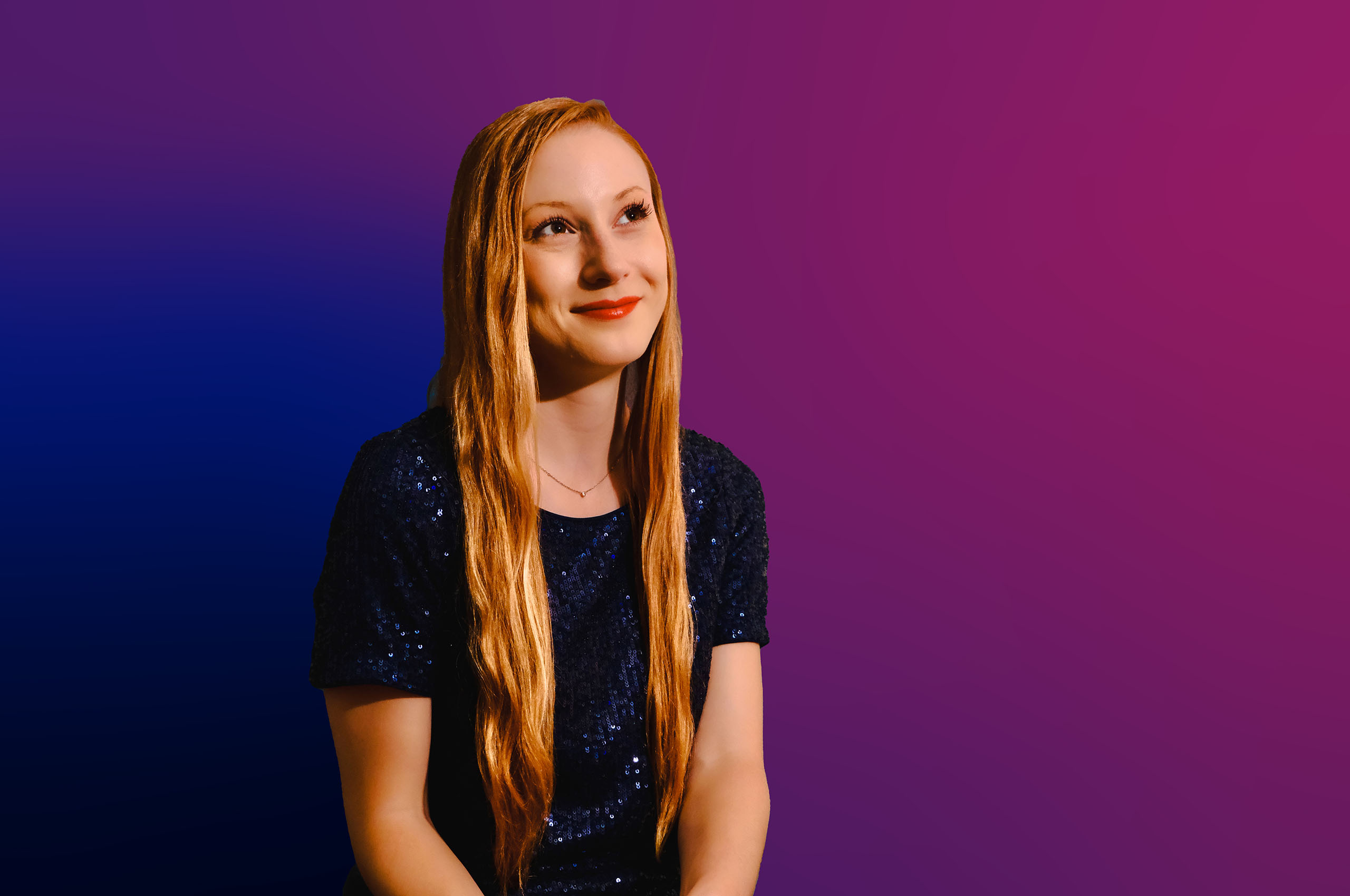
Gala Flagello (b. 1994) is a composer, educator, and nonprofit director whose work is inspired by a passion for lyricism, rhythmic vitality, and fostering meaningful collaboration. Her music, described as “at times endearingly whimsical, at times ominous, but always moving” (Cleveland Classical), resonates with audiences through its emotional depth and dynamic expression. Flagello’s collaborations with leading ensembles, artists, and institutions on national and international stages build impactful projects for audiences and performers alike.
Flagello’s 2024/25 season features the European premiere of Vitality with the BBC Symphony Orchestra, including an international performance broadcast, along with orchestral performances of Bravado by Detroit Symphony, Chautauqua Festival, Lansing Symphony, Wichita Falls Symphony, Central Ohio Symphony, and Dearborn Symphony. She is a recipient of the 2024 Barlow General Commission, which will support a new work for the Thalea String Quartet. This season also includes consortium premieres of Flagello’s Love & Nature, a wind band work commissioned by 55 ensembles across the United States.
Upcoming projects include a new piano concerto for soloist Henry Kramer and commissions from the Contemporary Youth Orchestra, the University of Nebraska–Omaha School of Music, and the University of Florida Bands. Album releases this season include Tallā Rouge’s Shapes in Collective Space featuring Burn as Brightly and a commercial recording of The Bird-While with Hub New Music and the University of Illinois Wind Symphony.