- This event has passed.
Symphony Orchestra: Pines of Rome
Free
October 8, 2025 @ 7:30 pm – 9:00 pm
Jungho Kim, conductor
Cori Trenczer, cello
Program
NIKOLAI RIMSKY-KORSAKOV
Capriccio espagnol, op. 34 (1887)
FRANZ JOSEPH HAYDN
Cello Concerto No. 2 in D Major, Hob. VIIb/2 (c. 1783)
III. Rondo: Allegro
OTTORINO RESPIGHI
Pines of Rome, P 141 (1924)
I pini di Villa Borghese (The Pines of the Villa Borghese)
Pini presso una catacomba (Pines Near a Catacomb)
I pini del Gianicolo (The Pines of the Janiculum)
I pini della via Appia (The Pines of the Appian Way)
Capriccio espagnol, op. 34
Considering the great interest in Spanish music demonstrated by the father of Russian art music, Mikhail Glinka (Glinka traveled extensively in Spain, collected folk materials, and composed pieces based on them), it is not surprising that a Glinka disciple such as Rimsky-Korsakov would look for similar geographic sources of inspiration. So it is that the Russian Rimsky-Korsakov conceived a fantasy on Spanish themes; he originally intended it to be for violin and orchestra. As it developed, however, the Capriccio espagnol came to be not only a virtuoso work for violin, but also a work that could rightly be subtitled “Fantasy for violin, clarinet, oboe, flute, horn, trumpet (etc., etc.).” Which is to say that while the composition’s accent is Spanish, its emphasis is on solo instrumental virtuosity as well as on the orchestral effulgence that is so typical of Rimsky-Korsakov.
The composer himself commented on the dazzling merits of the piece, saying, “It is intended as a brilliant composition for the orchestra. The change of timbres, the felicitous choice of melodic designs and figuration patterns, exactly suiting each kind of instrument, brief virtuoso cadenzas for solo instruments, etc., constitute here the very essence of the composition and not its garb or orchestration. The Spanish themes of dance character furnished me with rich material for putting in use multiform orchestral effects. All in all, the capriccio is undoubtedly a purely external piece, but vividly brilliant for all that.”
The piece is in five sections, played without pause.
1. Alborada. This “morning song” begins with eye-opening, full orchestral thrust, out of which emerge clarinet and violin solos, the latter ending the section quietly.
2. Variations. A simple Spanish folk melody is given by horns. Five variations—really just elaborations on the theme—exploit various solo voices, the last ending with languorous flute chromatics.
3. Alborada. The first section returns; here, violin and clarinet reverse their first-movement solo passages.
4. Scene and Gypsy Song. A side drum initiates a fanfare for horns and trumpets alone; solo trumpet blazes out the theme. Next, solo violin takes it up; then flute and clarinet, with percussion and strings accumulating. A flute plays a cadenza over a timpani roll, then clarinet over cymbals, after which there is a harp and triangle duet. Finally, the strings interject a ferocious idea; this is the gypsy song, which then alternates with the opening fanfare motif in orchestral splendor.
5. Asturian Fandango. Trombones present the first part of the theme, winds the second. After varying timbral treatment, the Alborada returns to bring the capriccio to a fiery close.
— Orrin Howard
Sinfonia Concertante in E-flat Major for Violin and Viola, K. 364
By 1779—a few years before Haydn wrote his Symphony No. 76—the 23-year-old Mozart was chomping at the bit to break free from the restrictions imposed by his employer in Salzburg, the Archbishop Colloredo. His recent tour westward to Mannheim and Paris had proved of decisive importance; it apparently stirred a desire to experiment with some of the instrumental forms and styles Mozart had been encountering.
One result was the Sinfonia Concertante, a work that bursts with the joy of exploring new instrumental sound combinations and possibilities. It also marks a sort of turning point, in essence summing up much of what Mozart had achieved to date as an artist. Not long afterward—and in part on account of indulging in such purely pleasurable creative endeavors, at the expense of his duties as court organist—he was summarily dismissed by his boss (as he sardonically puts it in a letter, “with a kick on my arse”) and left Salzburg for good to live in Vienna.
The genre here, as the name indicates, is basically a hybrid between the symphony and the concerto – what, later in the 19th century, would be labeled a double concerto for violin and viola. Yet the Sinfonia Concertante wondrously unifies these several dimensions. Like Haydn, Mozart exploits his rather modest orchestral ensemble to the maximum; there’s no percussion, nor even flutes or Mozart’s beloved clarinets, but he divides the violas into two for a richer string blend. The proportions of the opening movement (marked with the epic-sounding tempo “Allegro maestoso”) are generous and expansive, further contributing to the work’s symphonic aspect.
For many, this piece represents the grandest of Mozart’s violin concertos, surpassing the five official ones. At the same time, the viola is no second fiddle here. Mozart’s choice of instrument for the second soloist is telling: although an excellent violinist, he himself loved to play viola in string quartet ensembles, enjoying the perspective of being “in the middle.” One unforgettable characteristic of the Sinfonia Concertante is the remarkable partnership and equality shared by both soloists and the searingly beautiful sound blend they create. Mozart’s original score even inscribes the viola part in D major, thus requiring the violist to tune the strings up a half-step. The intention is to give the usually more-reserved viola a certain resonance to offset the violin’s usual limelight-hogging sonority.
The Sinfonia Concertante is in part about an extraordinary abundance of ideas and sonorities which – thanks to Mozart’s art – pour out with a seeming effortlessness, like ripened fruit simply there to be plucked. The opening orchestral exposition makes this clear, as one idea is laid out on top of another until, with a half dozen in the air, one loses track. And more are yet to come as the curtain opens and the soloists enter in one of the most sublime passages of all Mozart, soaring out from the background on a sustained high E-flat. It’s perhaps no surprise that George Balanchine choreographed a famous ballet to this music, for the role of the duo soloists entails a conversation not just with the orchestra at large but with each other (it’s intriguing, as well, to imagine Mozart’s own voice represented by the viola). This is clear in the many echoing passages he unfolds and in his construction of the cadenzas, expressly written out.
Beyond these instrumental dimensions, there’s yet another. This is the world of opera, of lamenting song, with a hint of archaic baroque sentiment, which comes to the fore in the sensitive and lengthy Andante, one of Mozart’s relatively rare minor-mode slow movements. Here we find an emotional depth that, as Maynard Solomon speculates in his notable biography, may reflect the composer’s experience of loss in coping with the recent death of his mother. Specifically, the duality of the violin-viola sound contributes to another aspect of the piece’s stunning beauty: listen as the solo violin takes up its plaintive aria of grief and the response from the viola, now providing a sudden but believable consolation. The two continue to form a complementary pair as Mozart unfolds his song seamlessly, virtually prefiguring what Wagner would later coin as “infinite melody.”
With the presto rondo finale, an irrepressibly joyful spirit returns. As Alfred Einstein observes, its “gaiety results principally from the fact that in the chain of musical events the unexpected always occurs first, being followed by the expected.” Or, to return to Hesse’s ethereal Immortals, the Sinfonia Concertante ends with their characteristic laughter, which is “laughter without an object…simply light and lucidity.”
— Thomas May
Pines of Rome
Respighi managed to get a couple of operas staged in his native Bologna by the time he was 31 years old, but work as an orchestral musician (violin and viola), teacher, piano accompanist, and arranger of Baroque music sustained his peripatetic career in its early years. A move to Rome in 1913 as professor of composition at the Liceo Musicale of Santa Cecilia proved decisive, since Rome was then the center of orchestral life in Italy. In 1916, he completed Fountains of Rome, a four-part symphonic tone poem that gradually became a huge success, making Respighi famous and wealthy.
In 1919 the Liceo became the Conservatory of Santa Cecilia, and in 1923 Respighi was appointed its director. He held that administrative post only three years, during which he composed Pines of Rome, a sequel to Fountains and even more lucrative for Respighi. Its success, following its premiere in December 1924, enabled Respighi to quit as director of the Conservatory in 1926, although he continued the teaching he loved, as an advanced composition professor there until 1935.
The great popularity of this music is not hard to understand. It is brilliantly evocative, well-crafted, and emotionally sincere musical pageantry. The first section of Pines – all four are played without a break – is a short prelude depicting children at play in the pine grove of the Villa Borghese, their dances and games raucously projected through quick brass and woodwind exchanges.
“Pines Near a Catacomb” presents a serene, even somber scene, with muted strings supporting an orchestral chant which “re-echoes solemnly, sonorously, like a hymn” rising from the catacomb, in the composer’s words.
“The Pines of the Janiculum” is night music in which a solo clarinet sings plaintively, introducing the actual song of a nightingale (Respighi even specified the recording to be used) over tremolo strings. “The Pines of the Appian Way” suggests morning dawning over the march of imperial Roman glory in trumpet-driven triumph. Mussolini adored Respighi’s orchestral music, but the sound of a fascist parade here is probably the result of purely musical muscle flexing rather than any consciously propagandistic intentions on the part of the rather non-political composer.
— John Henken
Cori Trenczer (Third Prize, Student Artist Competition)
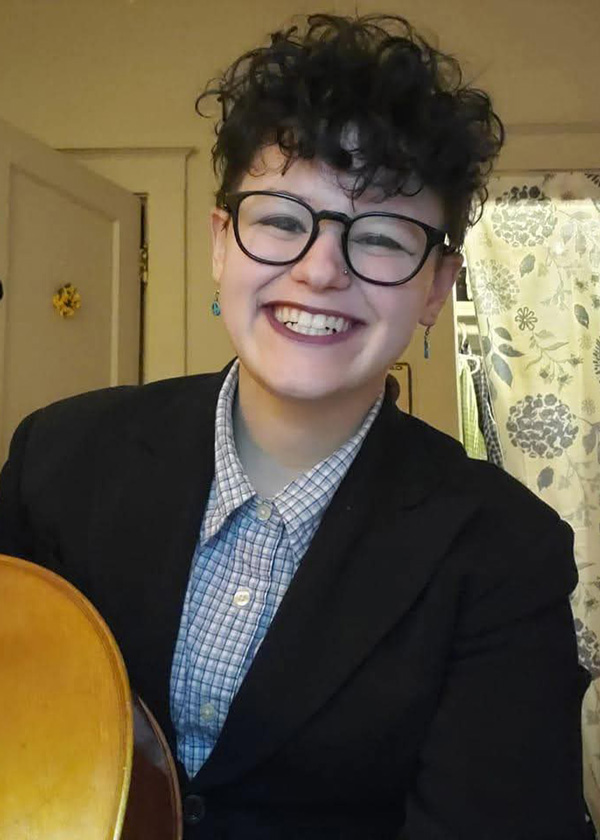
Cori Trenczer is a cellist, chamber musician, and teacher from the Hudson Valley region of New York. Coming from a musical family and a family of educators, Cori is both an avid performer and a teacher to a robust studio of cello students. Cori has her bachelors degree in cello performance from the Eastman School of Music and she is a graduate assistant in the graduate string quartet at UNCG.
Cori enjoys playing in the Greensboro Symphony Orchestra as a section cellist, and teaching her studio of roughly 18 cello students, ranging from age 8 to adult. She is interested in contemporary music and playing music by underrepresented composers. Cori is a virtual cello teacher on the faculty of Cornerstone Music Studios and on wyzant.com, and teaches in-person at Moore Music Company and through UNCG’S Community Music Lessons Program.
The vibrant UNCG Orchestra program has long been recognized for performance excellence, adventurous programming, and high artistic standards. A diversity of offerings allow students the opportunity to perform repertoire for ensembles ranging from the largest cornerstone and contemporary works for full orchestra, to intimate pieces for chamber orchestra, to string orchestra.
Students in the UNCG Orchestra program are dedicated to the performance, study and cultivation of orchestral music of the highest quality. The UNCG Orchestras offer outstanding performances throughout the year and enhance the institutional spirit and community of UNCG. We seek to promote music education in the state of North Carolina and in our region by supporting secondary school orchestra programs and other organizations through our outreach activities and other annual events on campus.
Event Details
October 8, 2025 @ 7:30 pm – 9:00 pm
Free
The importance of philanthropy has never been greater. Please consider a gift to the School of Music to support our mission and ensure the future of music at UNCG.