Downey Overture
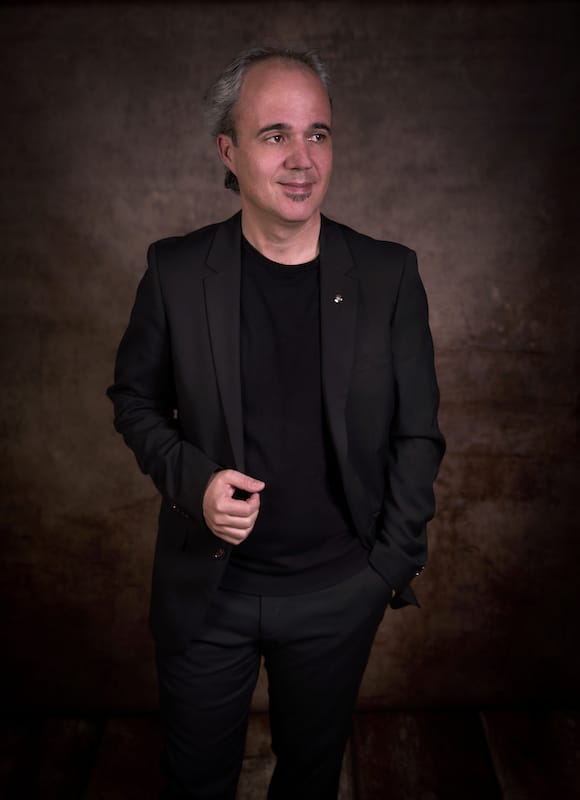
Óscar Navarro is a Spanish composer and conductor. He studied clarinet, composition, and conducting in Spain and later specialized in film and television scoring at the University of Southern California in Los Angeles. His music has been performed worldwide by orchestras and symphonic bands, including the Downey Symphony Orchestra, for whom this overture was written. Downey Overture was composed as a celebration of both Navarro’s native Spain and his time in California. It is dedicated to the Downey Symphony Orchestra and its conductor Sharon Lavery. Navarro describes the piece as “a Latin-American fusion…an amalgam of rhythm and musical color wrapped in an atmosphere of dance.” The overture opens with bold, dance-inspired rhythms, with percussion and winds engaging in rhythmic interplay. The music moves through contrasting sections, from lively to more dramatic, and concludes by returning to earlier themes, leaving a sense of energy and unity.
Note by Óscar Navarro and Molly Allman
Solemn Prelude
Ulysses S. Kay, an American composer and educator, was born in Tucson, Arizona, where he grew up surrounded by musical influence. His great-uncle, American jazz cornetist King Oliver, encouraged Kay to study piano. Kay studied at the University of Arizona, the Eastman School of Music, and Columbia University, working with mentors including Howard Hanson and Paul Hindemith. Over his career, he composed more than forty orchestral works, five operas, nearly fifty choral compositions, and seven original works for band, establishing himself as a significant twentieth-century composer. Kay was also one of the most successful African-American composers of his generation and gained widespread recognition in the classical world breaking barriers for other Black artists. He received numerous honors including a Guggenheim fellowship, two Prix de Rome selections, and six honorary doctorates. Despite his success and contributions, Kay’s band works remain lesser-known and infrequently performed. Solemn Prelude (1950) was commissioned by Donald I. Moore for the Baylor University Golden Wave Band. Initially published by Broadcast Music Incorporated and Associated Music Publishing, a typewritten note in the Ulysses Kay Archives indicates it was later listed as withdrawn, leaving it unclear whether Kay intended it to be published or performed. Solemn Prelude is composed in an ABA form and exemplifies Kay’s compositional philosophy: “I [am] using quite simple musical materials and avoiding all so-called ‘effects,’ [and] I have attempted to achieve symphonic expression while observing the characteristic qualities of the full concert band.” The slow and melodic work is built from a recurring rhythmic motive in D Minor, first heard in the saxophones and low brass, which accompanies the opening euphonium solo. Then solo passages are passed across the ensemble to include flute, oboe, trumpet, and bassoon. The initial rhythmic motive returns and dominates the texture in the closing measures.
Note by Patty Saunders
Song and Dance
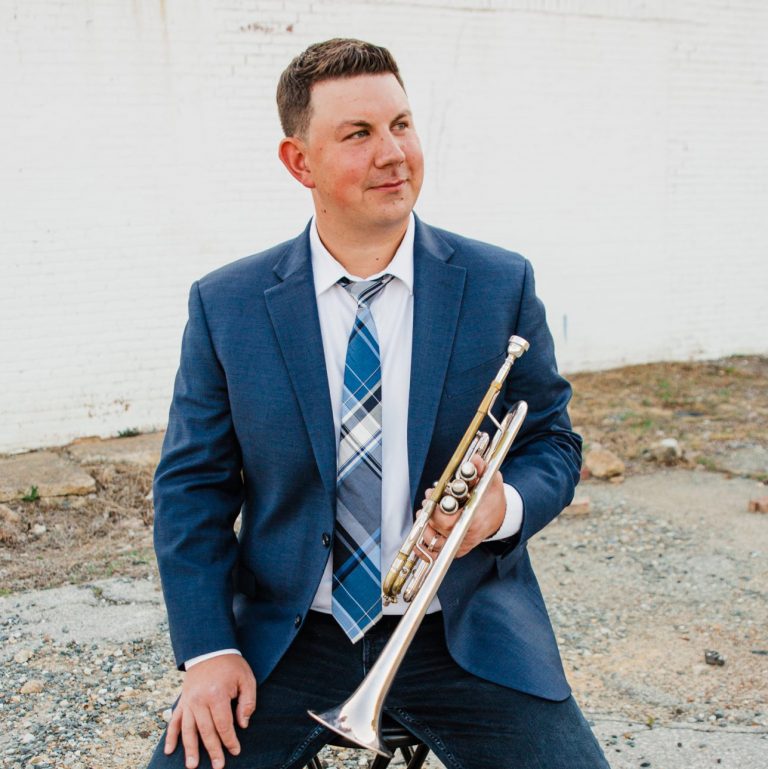
Philip Sparke is an English composer who has written extensively for brass band. In 1983, the GUS Band, a British brass band, commissioned Sparke to write Jubilee Overture for an upcoming recording session and to celebrate their 50th anniversary. Following the success of Jubilee Overture, the band commissioned Song and Dance the next year. In 2009, Geoffrey Brand arranged Song and Dance for solo cornet and concert band. Song and Dance is a single movement piece in two sections, a song followed by a dance. The “Song” features a “Scotch snap” rhythm followed by a lyrical cadenza leading to a muted presentation of the opening theme. The “Dance” is lively and tuneful with frequently changing meters to accompany the dancing melody.
Note by Philip Sparke and Jaden Brown
Pageant, op. 59
Vincent Persichetti was an American composer, educator, and pianist, and an influential figure in early band literature. In the immediate aftermath of World War II, bands struggled to program substantial, original repertoire written specifically for band. Persichetti’s insistence on composing high quality music helped move the medium forward in many ways. In 1952, Edwin Franko Goldman, founder of the Goldman Band in New York City and the American Bandmasters Association (ABA), commissioned Persichetti to write a piece for the upcoming ABA Convention. Pageant was premiered at the 1953 ABA Convention in Miami, Florida with Persichetti conducting the University of Miami Band. Early manuscript sketches of Pageant show that the piece was initially meant to be titled Morning Music for Band. Traces of the idea of “morning music” can be heard in the opening horn motif and the clarinet soli that follows. The piece is in two sections, the first being slower and more lyrical and the second being a “parade” section introduced by the snare drum.
Note by Vincent Persichetti and Jaden Brown
Soñad el mar
Manuel Morales Martínez is a Spanish composer and conductor whose work focuses on wind ensembles across the Valencian region, a heartland of Spanish band music tradition. Soñad el mar was composed in 2017 for the Banda Primitiva de Rafelbuñol and is a concert pasodoble. While a concert pasodoble maintains the characteristic pasodoble rhythmic framework, these pasodobles are slower and more formally, harmonically, and melodically complex than a traditional pasodoble. The piece begins with a percussion-driven introduction, leads into a bold main theme, and features solos for horn and english horn in the trio section before returning to the main material. Throughout, the music recalls the gentle motion of the sea while retaining the characteristic pulse of the pasodoble. Martínez describes the work as “tonal, Romantic style and captures the calmness of the Mediterranean Sea.”
Note by Manuel Morales Martínez and Molly Allman
Country Gardens
Irish Tune from County Derry
Shepherd’s Hey
Percy Grainger (1882–1961), an Australian-born composer and pianist, played a pivotal role in the early development of band literature in the early twentieth century through innovative orchestration and adventurous rhythms and meters. Known for his inclusion of folk melodies, Grainger used Edison wax-cylinder phonographs to collect English folk songs throughout Britain often collaborating with Cecil Sharp, a renowned collector. Fascinated by the unique performances of the singers and often integrating the tunes into his compositions, he sought ways to capture the nuances of pitch and rhythm in his works. Grainger’s contributions to band repertoire include cornerstone works such as Lincolnshire Posy and Colonial Song. Country Gardens (1918) is an English folk tune shared with Grainger by Cecil Sharp based on the tune “The Vicar of Bray.” Grainger played improvisations on it as a concert pianist during his tour for the U.S. Army during World War I and later presented the song to his mother as a birthday gift. Despite its immense popularity, Grainger referred to it as “my wretched tone art.” Grainger arranged the piece for band in 1953. In his program notes, he wrote: “The typical English country garden is not often used to grow flowers in; it is more likely to be a vegetable plot. So you can think of turnips as I play it.” Irish Tune from County Derry (1918) highlights the lyrical beauty of folk song. The tune was collected by Miss J. Ross from New Town, Limavady, Co. Derry, Ireland without a specific tune being credited. Grainger stated, “The name of the tune unfortunately was not ascertained by Miss Ross, who sent it to me with the simple remark that it was ‘very old,’ in the correctness of which statement I have no hesitation in expressing my perfect concurrence.” The melody is shared by the song “Danny Boy,” whose lyrics were composed by English songwriter Frederic Weatherly after Grainger had already arranged the tune. Grainger also arranged the melody in a version for wordless chorus. Shepherd’s Hey (1918), published and sold with Irish Tune from County Derry for many years, is a lively arrangement of a Morris dance tune from rural English tradition. The “Hey” in the title refers to a specific Morris dance step, though Grainger noted, “This setting is not suitable to dance Morris Dance to.” Morris dances traditionally feature teams of “Morris Men” performing with bells and clashing sticks. Grainger collected the original melody and states that the work should be played “in a jolly, energetic manner—with bounce and relish.”
Note by Patty Saunders