Staying Power: Initiative for Public Art and Aging is a community and arts-based research project that has grown out of the Creative Aging Network-NC Art Initiative developed by School of Art Professor of Sculpture Kasia Ozga alongside interdisciplinary UNCG faculty and community partners. The team’s research focuses on activating movement in older adults through public sculpture and brings together the School of Art with the Departments of Gerontology, Kinesiology, Human Development and Family Studies, and Interior Architecture.
Since 2023 UNCG and the Creative Aging Network of North Carolina (CAN-NC) have pursued an interdisciplinary arts- and community-based research project combining public art and experiential learning in Northeast Greensboro. The CAN-NC enhances the well-being and social connections among older adults through North Carolina through artistic programming, which is multicultural and multigenerational. This partnership seeks to lay the groundwork for more sustained research into interactive public art specifically geared towards aging populations while exposing university students to positive expressions of aging.
From 2024 to 2025 under the leadership of the project’s advisory council, UNCG School of Art Students enrolled in Sculpture 1 and 2 participated in a year-long proof-of concept process that resulted in the production and installation of a large-scale permanent sculpture on CAN-NC’s woodland campus. In the first semester, students made temporary environmental and site-adjusted artworks at CAN-NC and learned about public art, benefitting from lectures by Professors Elise Eifert (Gerontology) and Louisa Raisbeck and Anne Brady (Kinesiology), as well as technical lectures from local public art professionals at Beechwood Metalworks. For their final project of the semester, twenty students spent a month preparing maquettes and posters exploring ideas for full-scale permanent artworks on-site. This experience culminated in a public presentation in December 2024 at CAN-NC with an external jury of industry professionals.
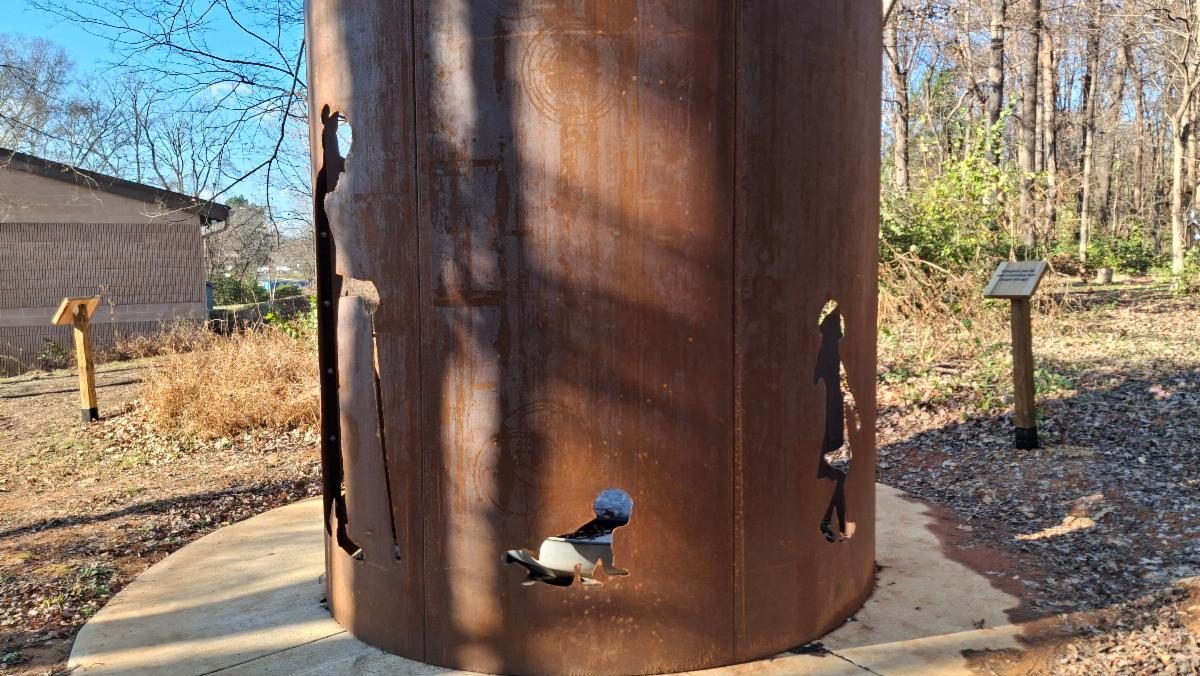
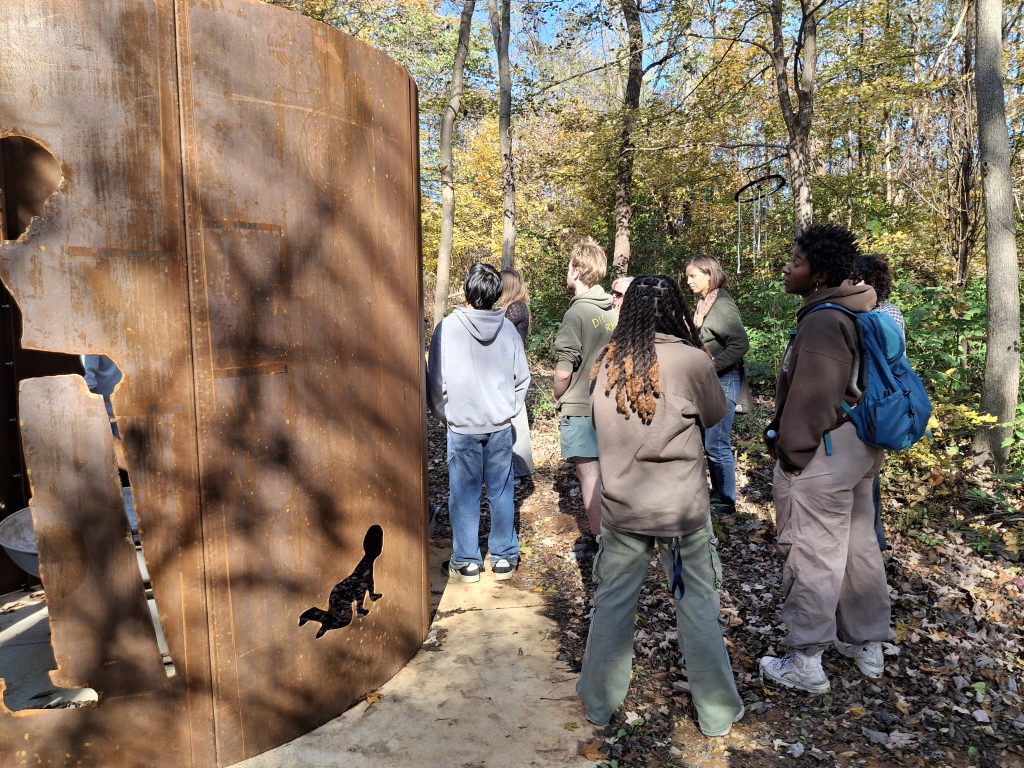
The sculpture selected by the jury was completed by students before the end of the spring semester, disassembled, and delivered in parts to CAN-NC in late April 2025 and installed by CAN-NC community volunteers over the summer. A new group of students in a Fall Public Art Class translated a series of questions into signage around the work, intended to stimulate discussion and reflection. Professor of Interior Architecture Derek Toomes assisted students in using digital CNC technology to produce these pieces, which were installed in November 2025, extending the reach of the initial artwork.
Executive Director/Co-founder of CAN-NC Lia Miller reflected on the strength of the partnership between her organization and UNCG:
“Our partnership with UNCG School of Art on this project has been a deeply rewarding experience. I’ve especially loved the intergenerational engagement—seeing elders serve as advisors to the students, witnessing the students’ amazing creativity, and watching our campus become more vibrant and beautiful….We hope to maintain a strong, collaborative relationship with UNCG that honors the community partner’s vision and the spirit of partnership that makes this work so meaningful.”
This initiative is not new territory for Professor Ozga:
“My PhD was in sculpture and public art and the question of how public works stimulate dialogue and engagement is deeply intertwined in my own practice. I am excited to expand the scope of our research collaboration at UNCG with dependable community partners who appreciate the labor involved in producing public art and can invest resources towards mutually beneficial outcomes.”
The success of the project so far as been felt by all involved, including Daris Garnes, a member of the Elder Advisory Council through CAN-NC:
“I loved being a part of the UNCG School of Art and Creative Aging Networks partnership. It was great to see the students’ murals and environmental sculptures. Experiencing their fresh ideas was inspiring, and I loved sharing my creativity with them.”
This project has intentions of being sustainable long-term with multiple community partners, expanding its scope and reach. The work already completed at CAN-NC lays the foundation for more long-term collaboration with other older-adult communities in the Triad and beyond. Professor Ozga has already begun conversations in the summer 2025 with potential future community partners for new project development, with hopes that it comes to fruition in 2026. She is excited to extend the existing work with new thought partners. As the team expands the scope of their undertakings, they aim to partner not only with non-profits focused on older adults living independently, but also with institutions and public entities here in Greensboro/Guilford County.

In addition to receiving multiple internal grants to support this community-engaged research, including the CVPA Community Engagement Grant and the Partnerships & Pathways Grant from UNCG’s Institute for Community and Economic Engagement, Professor Ozga also used this research proposal as a catalyst for the 2025 Summer Faculty Community-Engaged Course Development Grant and Workshop geared at integrating the project into course content for the Art Course: Site-Specific Sculpture 3. Other funding support has been provided by the Undergraduate Research, Scholarship & Creativity Grant, as well as the Triad Retirement Living Association.
Interdisciplinary team members from across UNCG are Professors Elise Eifert (Gerontology), Louis Raisbeck (Kinesiology), and Sudha Shreeniwas (Human Development and Family Studies)—these faculty members specifically assisted with grounding this work in existing theoretical and applied research on sensory change and stimulation on older adults. Professor Derek Toomes (Interior Architecture) assisted with the technical side of the project, supporting project development.
Story by Caitlyn Schrader
Photo credit: Kasia Ozga