“This course has been a source of inspiration and affirmation that doing what I am passionate about really can become a career. As arts students, that’s something we struggle with a lot,” says Leah Dickinson with a big sigh. “Everyone’s telling you all the time you’re not going to make any money; you’re not going to make an impact. But there are people out there, like us, who are making a career out of their art and doing exactly what they want to do.”
Leah is one of six students in a new transdisciplinary entrepreneurship course in which students learn how to bring their creative vision and strategic planning together to forge a sustainable career.
At the Intersection of Creative Practice and a Business Plan
With funding from an Innovate UNCG grant, CVPA’s new transdisciplinary course, “Empowered Creativity: Collaborative Entrepreneurship in the Arts,” was designed by professors from each of the College’s four disciplines— Anna Dulba-Barnett (School of Theatre), Marielis Garcia (School of Dance), Hannah Grannemann (School of Art), and Stephanie Ycaza (School of Music). This semester is the first time it has been offered and is being taught by Garcia and Marian Taylor Brown (Assistant Professor of Arts Administration). Garcia explains:
“We developed a game plan—the syllabus—for a workshop-style course in which there is an incubator period for ideas and then adding the skills needed to bring the ideas to fruition. Things like communication, collaboration, technology, finances, marketing, all of which will culminate in a final project.”
Garcia is a teaching artist with years of experience making art and getting it produced. She sees great benefit in helping students find that intersection early:
“Each of our schools has some kind of entrepreneurial course specific to that school. What’s different about this course is the interconnectivity of the arts through this entrepreneurial mindset in a co-artistic way. And that’s the way the world works, where not everyone on a project is a musician or a dancer or a visual artist, rather you collaborate with people in different mediums. So, getting that practice while still in school is crucial.”
Brown brings to the course a background in social entrepreneurship with artists and doing collective and interdisciplinary work:
“That’s a huge part of why I was hired into Arts Administration, so this course feels like a natural fit. I remember one of our first conversations about what these things mean to us as a studio artist, as a dancer, as an arts administrator, and there were so many pieces around how we make sense of creative iteration and innovation that the two of us I think have really been able to build beautifully that holds the strong entrepreneurial skill set, but then also really honoring the artistic practice. I think we’ve been doing that dance very well.”
Arts Entrepreneurship with a Modern Spin
Entrepreneurship in the arts is not new. Artists have always had to find ways to present their work. What has changed is the way arts programs are teaching the concept. That, and the way artists are finding it increasingly important to work together across disciplines. Marian Taylor Brow explains:
“We’re seeing tremendous restructuring and de-siloing in large part brought on by the realities of the COVID-19 pandemic. If you look at what’s happened over the last six years, the skillset our students need to have upon graduation has changed drastically. There’s a real need for this deeply collaborative and transdisciplinary approach in their work and in learning what it means to be human with one another in this thing I call Earth School.”
Garcia adds that business skills are a bigger part of the picture now:
“It’s true that post-pandemic, the transdisciplinary nature of the arts world is even more pronounced, and business acumen is increasingly more important. From the angle of a dancer, you must be able to market, do finance, understand enough of the musical context to then be able to work with a music collaborator, or work with visual artists creating sets. This is not a new practice, but in a collegiate context, we’re putting that into practice in a place where students can ‘mess up’ and learn from that.”
Mentors and Guest Speakers Bring Real World Perspective
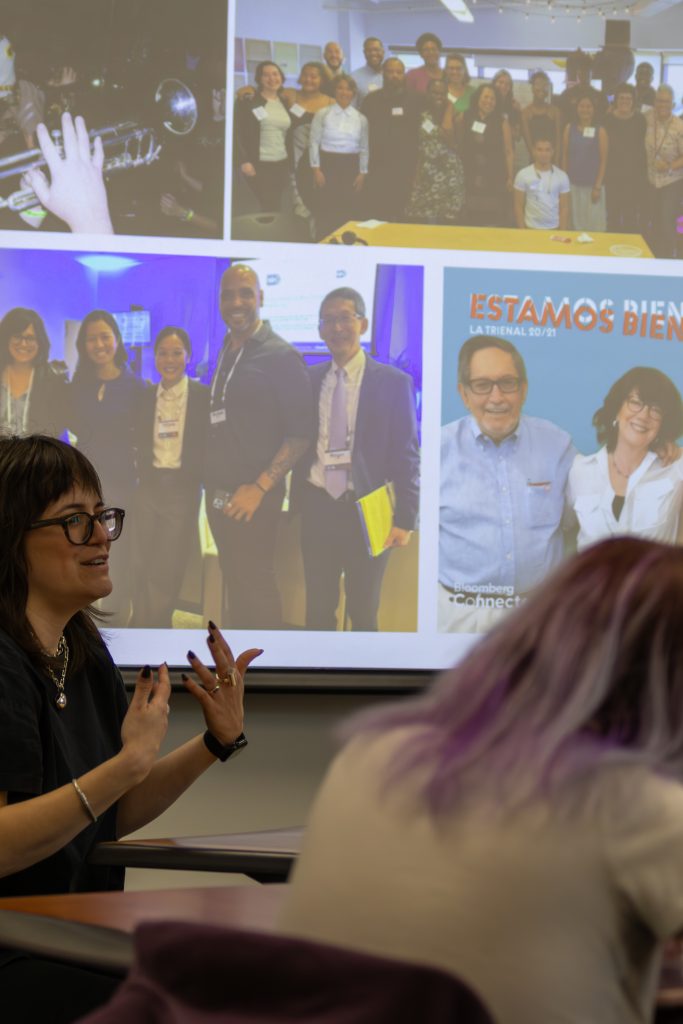
As Brown and Garcia lead the course from week to week, they weave in a variety of perspectives from other artists and administrators. Guest speakers have included Lalenja Harrington, musician and Assistant Professor in UNCG’s Department of Educational Leadership and Cultural Foundations; Hannah Grannemann, writer and Associate Professor of Arts Administration; Kate Ladenheim, choreographer, creative technologist, and educator; and Kara Elliott-Ortega, Senior Program Officer for the Arts and Culture Program at The Kresge Foundation.
In addition to guest speakers, the course has the added element of mentorship, which Garcia describes as follows:
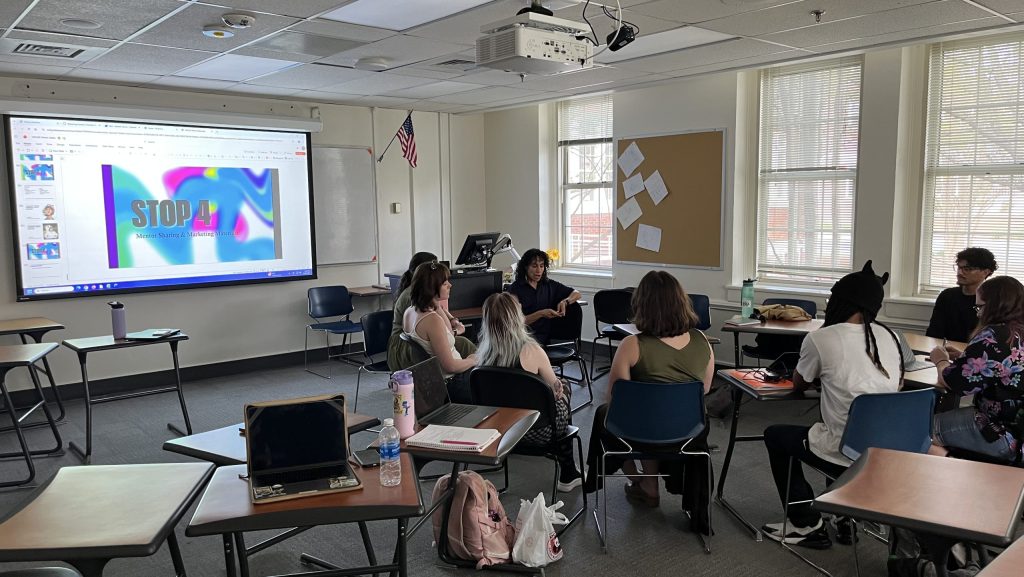
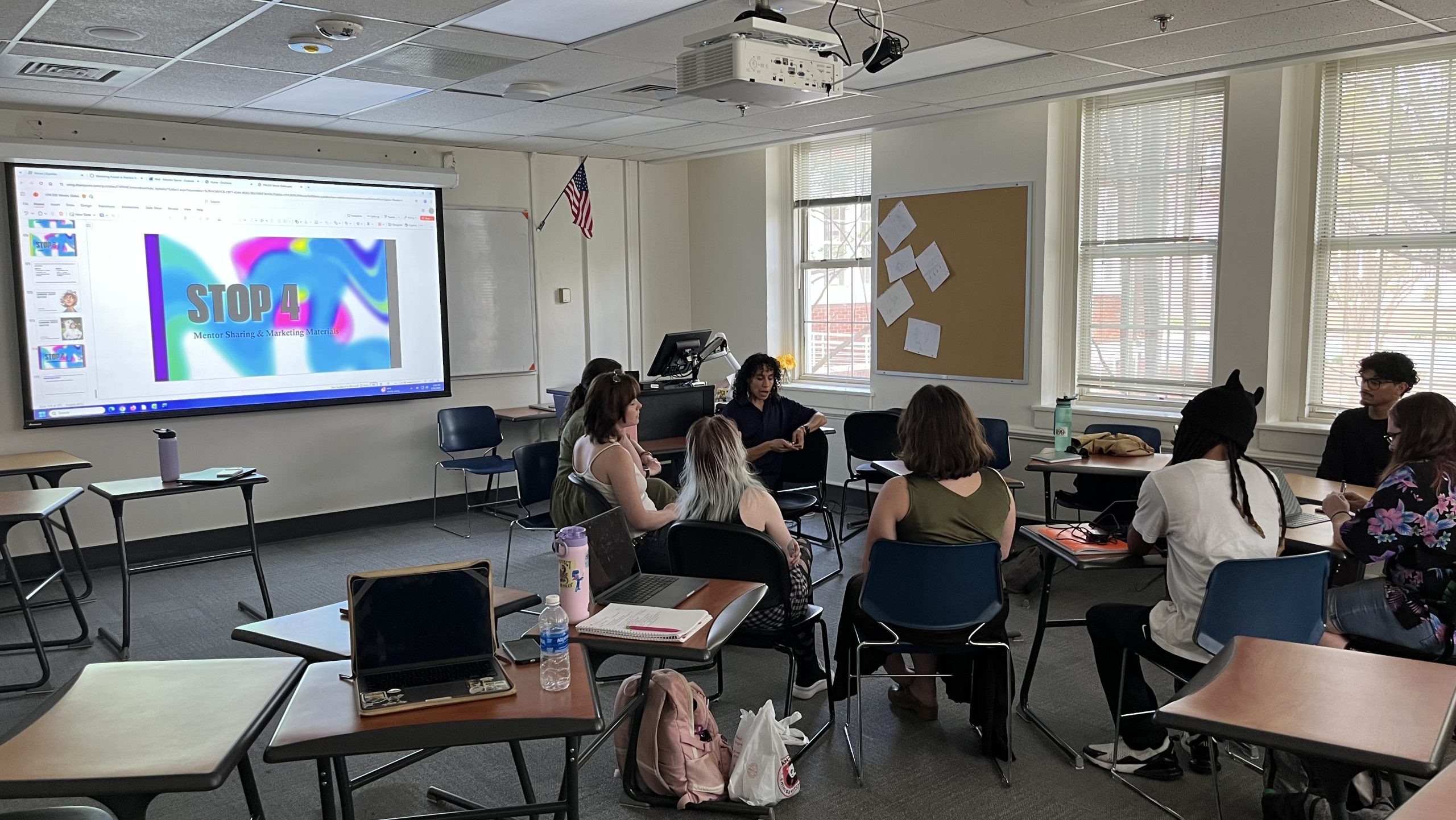
“We have two mentors, Amanda Graham, who is the Director of UNCG’s Tannenbaum Center for Creative Practice and Jaykishan Patel, a marketer who works primarily with tech companies. The students are divided into two groups, and each group pitches their project to their mentor and they must explain what they’re doing and why this benefits the community. The mentors give them feedback about areas to which they might pay more attention. This gives the students an outside lens of a professional doing the work of this collaborative practice, as they create something for not only for their university community, but they’re also thinking of the broader community and how their work might sort of exist beyond UNCG.”
When it came time for the teams to pitch their ideas to a mentor, they described the events they’d like to produce, both of which combined visual art and music. Brown says it was gratifying to watch how the project ideas evolved from early classes to that point:
“We had this sweet moment when they started to share their ideas. All the students were talking about what they’d be doing at the event which would be followed by Q&A. My question for them was, ‘If you are all engaged in the creating of the art, then who’s administering it?’ And that’s when they realized that recognizing what all the other parts are is what it means to be holding the art in totality.”
Garcia adds:
“Arts administration is so interconnected into the work that we do. You’re creating an artwork and you have to e-mail the venue. You have to confirm the materials. Maybe a project partner can’t make it to your meeting, so you must e-mail and find a new time. There’s so much administering in addition to being the artist, being the facilitator, being in the space of creation. And I think this course does a beautiful job of getting students to think of that split mind, and how it’s sort of a Venn diagram of experience. How can they co-exist as administrators and as creatives and where’s that sweet spot for them? And that’s where the practice comes in.
From Course to Career: Students Weigh In
The first cohort for the new transdisciplinary entrepreneurship course is made up of a half dozen students studying Art and Music. At a recent visit to the class, students were asked if they felt like the course was delivering career preparedness. The answer was a resounding, “Yes!”
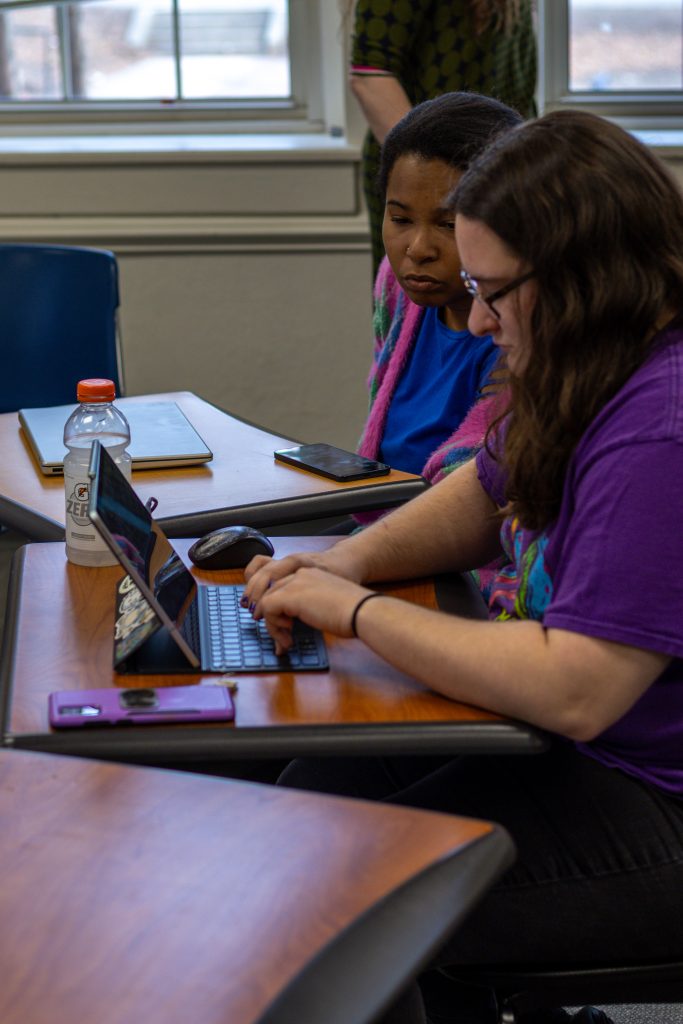
Sophia Syphers is a third year Arts Administration student focusing on historic art preservation:
“In a lot of courses, you feel like you’re just dipping your toes in, but in this course, you are all the way in the water. But you’re not alone. You have support of the others who are in it.”
Leah Dickinson, a sophomore in the Pop Tech program minoring in interdisciplinary arts and social practice agrees:
“This feels like the real deal. Sitting in my other courses sometimes feels conceptual, but this feels like I’m doing it right now— marketing, budgeting, event planning— so many perspectives from working artists who have been guest speakers in this course. And truthfully, they’ve helped us look at things like marketing and budgeting without the gloom-and-doom idea that artists must be controlled by that. It can be fun and it can be honest. Those things can be vulnerable and authentic to our art.”
Katherine Luke-Figuly, and senior, is also in the Pop Tech program:
“This is not just teaching and learning. We’re building an event that we can put on our resumes, that we can put on social media, and that we can use to market ourselves. It feels so real and tangible.”
Beyond career preparedness, the students say that the format and pace of the course just feel right.
Reagan Wirf is majoring in Arts Administration:
“Marian and Marielis have done a great job of holding our hands through the steps while treating us like capable adults. This has been a beautiful and amazing learning environment. I have a lot more mindfulness about, quite honestly, everything. We’ve done interpersonal reflections, talked about how we see each other and how we see the world.”
“This course introduced us to the idea of true collaboration,” remarks Leah. We’ve really been able to form a tight knit community which has made the collaboration easy. It’s felt natural and I feel like we can all share ideas and be creative”
Cochise Miles, a senior Arts Administration major, sees collaboration as the key takeaway:
“It’s the most important lesson we’ve learned—how to collaborate and the importance of getting to know your project partners, to form bonds that make collaboration more effective.
“I also appreciate the opportunities presented to us in this course. We’ve had so many visitors who are active in the field. And they seem more than willing for us to reach out to them for advice. As artist or a person in any creative field, these kinds of connections are extremely important.”
Na’Teasiha Whitfield is a sophomore Arts Administration major:
“The mentors gave us outside perspective and insight as we were forming our final projects. They had great advice for our planning, marketing, and creating our event budget.”
The events the students have planned will be held on campus on April 19th and 24th. What has already been determined is that students give this new transdisciplinary entrepreneurship course a solid A:
“One of the coolest things about this course is that for our final exam, we’re not just taking a test or creating a slideshow presentation,” points our Leah. “We are creating an event which is actively benefiting our future careers by teaching us how to make something happen—and that is very impactful.
“For me, this is one of my favorite courses I’ve had at UNCG,” says Sophia. “I am going to remember this experience for the rest of my life.”
Story by Terri W Relos
Photo credits: Judith Briand and Terri W Relos