It’s a career you might not think of right away—one that combines music and the military—but it’s one that some School of Music alumni say has served them well, such as Master Sergeant James Miller (’08 MM Flute Performance):
“You get paid to play. I think most people don’t understand how uncommon that is. If you’re a musician and you’re not looking into the military as a possible career, then you probably should.
“What I’ve seen over the last ten-to-fifteen years is that the musical landscape has changed a lot. And I think part of the challenge of music programs is keeping up with that and training people to do something new.”
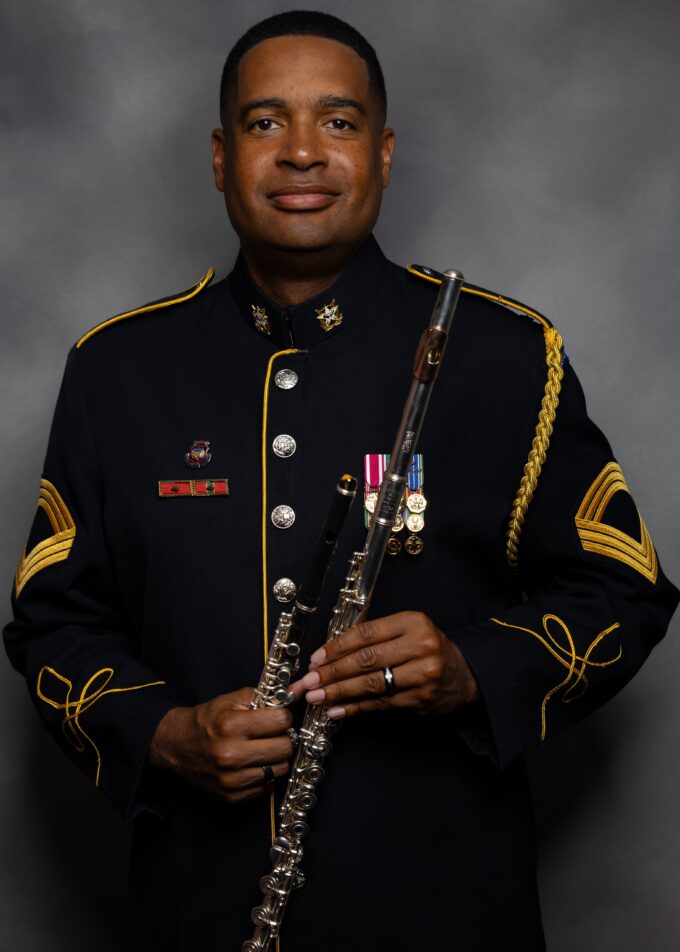
Master Sergeant Miller has been with the U.S. Army Ceremonial Band, “Pershing’s Own,” since 2013. He says he’s glad he took the path from music school to the military:
“It’s not where I ever pictured myself winding up even though I come from a long line of people who served. Both of my parents were in the military. My grandparents were, too. I’m kind of glad life brought me this way.”
According to its website, the U.S. Armed Forces is the oldest and largest employer of musicians in the world, with about 6,500 musicians in 130 ensembles across various branches, including the Army, Navy, Marine Corps, Coast Guard, and Air Force.
Master Sergeant (ret.) Melinda “Mindy” Burts (’97 MM Clarinet Performance) started down the teaching path before changing her course to the U.S. Air Force:
“My bachelor’s degree is in Music Education. My parents convinced me that it would be more employable than a performance degree. But by the end of that I knew that what I really wanted was for someone to pay me to play the clarinet.”
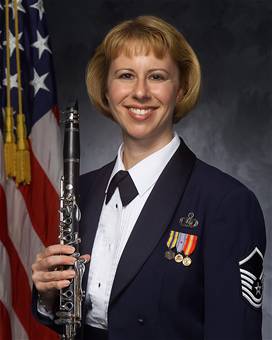
Master Sergeant Burts felt she needed more training, so she came to UNCG for her master’s degree and then started auditioning.
She landed a job with one of the military regional bands at Langley Air Force Base. Having her heart set on being in one of the Armed Forces’ premier bands, she kept auditioning until she got the position with the Air Force Concert Band:
“Our mission was mostly ceremonial and recruitment. Some days we’d be in rehearsal, then we might be gone for two or three weeks on tour. Some days we had ceremonies that required being up at the crack of dawn and other times we had local concerts in the evenings. The schedule was varied but the income was steady, and that’s important!”
Technical Sergeant John Reyna (’21 BM Tuba Performance) has only been with the U.S. Air Force Concert Band since January but is already realizing that being a military musician is a rewarding career:
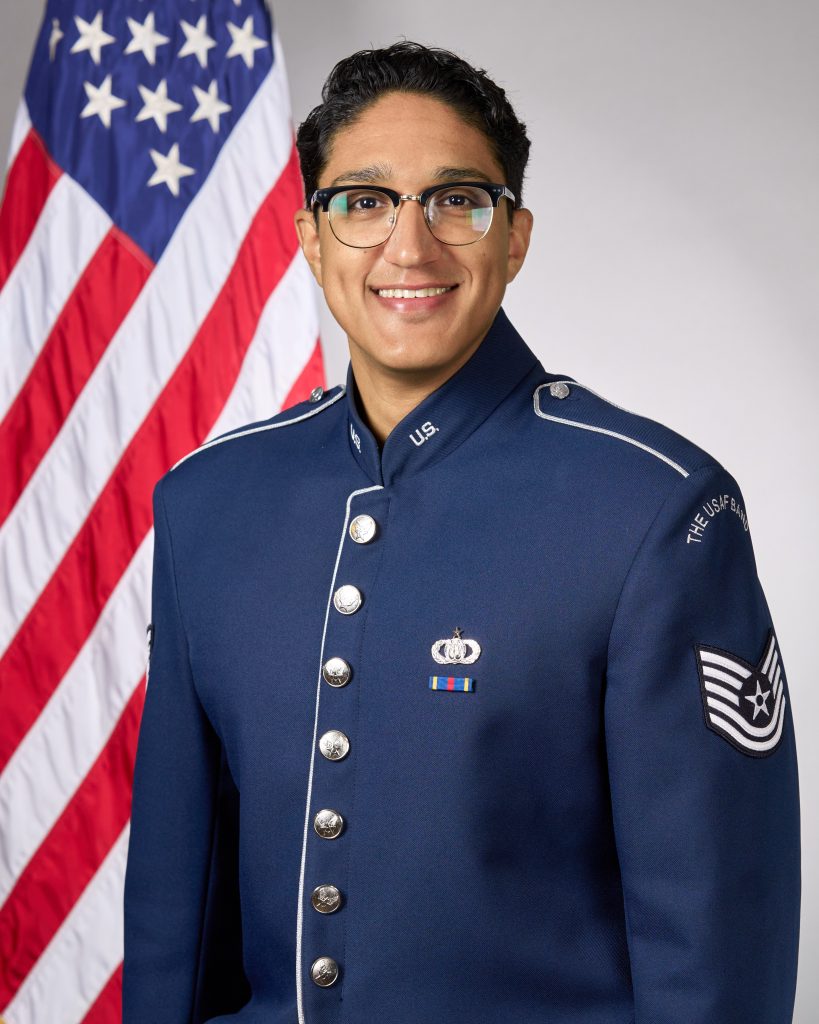
“The people are incredible. Not only are they fantastic musicians, but everybody is so kind. And everybody wants to be there, and we’re getting to play some really amazing literature. It’s exciting going to work, and this is probably the best work-life balance job a musician can have.”
Master Sergeant Miller agrees about the work-life balance:
“My primary duties are ceremonial, such as events at Arlington National Cemetery and elsewhere around the District of Columbia, including the White House and the Vice President’s home. Sure, we have things that don’t have as much notice, like a state funeral. But for the most part there is great stability in this job.
“I had dreamed of playing in an orchestra, but by the time I got to graduate school, I realized there aren’t that many orchestras, and there are a lot of people with performance degrees. I started thinking about how I would be able to make a living by playing music. I know you love your instrument, but you have to have health insurance. You may want to take a vacation.”
Being a military musician may be a good, steady job, but for all three alums, there’s more to it than that:
“I love playing for people,” says Master Sergeant Burts. “I love seeing the reactions in the audience when they are happy or excited. I know I’ve played the Armed Forces medley about a thousand times—we played it at the end of every concert—but it always gets everyone pumped up, and it’s still fun. That was always my favorite part.”
Technical Sergeant Reyna says he became aware of military bands in high school and wanted to be a part of that tradition:
“These military bands have most of the major recordings for a lot of well-known band literature. So, in high school when I was really getting into it, those were the recordings I ended up listening to. It was always in the back of my mind, wanting to be in an ensemble like that, knowing that that’s one of the highest caliber ensembles you can be in as a tuba player.”
“There’s something special about being a part of history,” adds Master Sergeant Miller. “We’re involved in major events that have happened in our country, whether good or bad. My first big job when I got to D.C. was an event at the Tomb of the Unknown Soldier, and President Barack Obama was there. That was the first time I played for a President, and there he was, just twenty feet from me with his wife and daughters. It was surreal.”
Master Sergeant Burts recalls a particularly impactful day for her:
“It’s the most important performance of my entire career. I played at the opening of the Pentagon 9/11 Memorial, which was one year after the tragedy.
President George W. Bush was there, along with Secretary of Defense Donald Rumsfeld, and it was such a moving experience.”
Although they are each in a different stage of their career—Master Sergeant Burts is retired, Master Sergeant Miller is about midway in, and Technical Sergeant Reyna is just starting out—they all got the preparation they needed at UNCG’s School of Music. Master Sergeant Burts came to study with Dr. Kelly Burke:
“Dr. Burke is a well-respected clarinet teacher and studying with her was a time to focus on clarinet and refine my playing so that I could win an audition. The audition circuit is tough, and taking an audition is its own skill.
“I played in the wind ensemble and orchestra, and we had studio class once a week. Dr. Burke made everyone understand that if it was your week to play you dressed up because it was a performance. She encouraged us to do all the recitals we could because she understood that the best thing to do was to play in front of people as much as we could.”
Master Sergeant Miller had heard of the School of Music’s reputation, and when he was offered an assistantship to help pay for tuition, that sealed the deal:
“It was great playing in the orchestra, chamber music groups, and in the wind ensemble. There were high-pressure moments, but I got valuable playing experience. The other studios were full of great musicians, and I got the opportunity to play with them in the ensembles. I really enjoyed working with the collaborative piano faculty—it was like getting coached by world-class pianists.
“While I was there, the Wind Ensemble made a recording that was nominated for a GRAMMY®. I also won the concerto competition, so I got to solo with the orchestra. I think the size of UNCG’s School of Music was good for me, giving me a lot of opportunities that allowed me to help build my confidence.”
Technical Sergeant Reyna’s introduction to UNCG was through the Summer Music Camp where he met tuba faculty members Drs. Dennis AsKew and Justin Worley:
“One of the things I loved about UNCG was that it felt like there was this competitive atmosphere, but we were all friends. It wasn’t like everybody was going out for each other. I felt like I was learning and growing along with all my colleagues, and we were all trying our best at the same time, especially the ensemble led by Dr. John Locke.
“Dr. Locke treated us like professionals and expected us to be prepared. You knew you’d better be prepared at that first rehearsal, or he’d call you out. That was the expectation across the board—with orchestra and chamber ensembles, too. And the music the students were making showed it.
“Honestly, one of my most meaningful concerts so far has been Dr. Locke’s retirement concert when I was a sophomore. It was so powerful.”
And that’s what it’s about to these three military musicians—finding ways to create meaningful lives in the arts:
“I think as artists or musicians we can often be very self-absorbed, and we kind of get into our craft and strive for perfection” says Master Sergeant Miller. “We are constantly asking ourselves why we do what we do. But as military musicians, we serve our country. We play for families who have lost people and who have served our country. I don’t have to look for meaning in my job. It’s there every time I pull out my flute or piccolo to play.”
Story by Terri W Relos
Photos provided by the U.S. Airforce and the U.S. Army